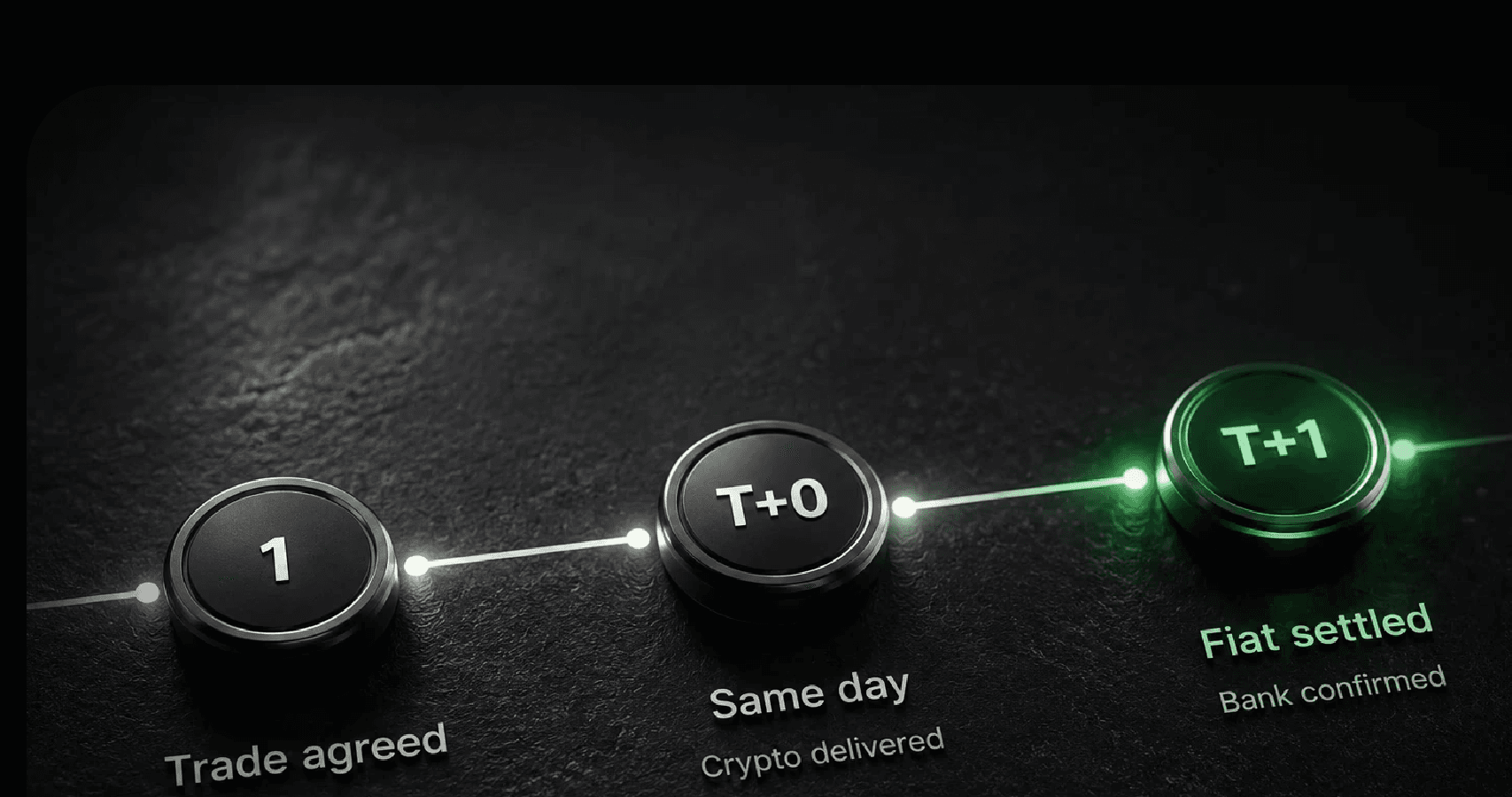
When you agree a trade with an OTC desk, execution and settlement are two different events. Execution is the moment the price is locked. Settlement is when the assets actually change hands. Understanding the timing between them, expressed as T+0 or T+1, is essential for any business planning its cash flow around digital asset transactions. This resource explains what those terms mean and how settlement works in practice.
What T+0 and T+1 mean
The T stands for trade date, the day the transaction is agreed. The number that follows is the count of business days until settlement completes. T+0 means settlement happens the same day the trade is executed, often within minutes. T+1 means settlement completes on the next business day. The convention comes from traditional finance, where securities have long settled on delayed cycles, but it maps directly onto digital asset trading and gives both sides a shared language for when value will move.
The practical difference is about certainty and cash flow. With T+0, funds and assets are available almost immediately, which suits time-sensitive payments and treasury moves. With T+1, there is a short, defined delay, usually driven by banking hours or the timing of a fiat leg. Neither is inherently better. What matters is that the timing is known in advance so the business can plan around it.
What drives settlement timing
Crypto and fiat settle on very different clocks, and the slower of the two usually sets the pace. Blockchain settlement is fast and runs around the clock, but bank rails do not. A few factors determine whether a given trade lands as T+0 or T+1:
- Banking hours and cut-off times, since fiat payment rails only process within defined windows and stop for weekends and holidays.
- The direction of the trade, because an on-ramp waits on incoming fiat while an off-ramp waits on the fiat payout leg.
- The network chosen for the crypto leg, where fast, low-cost chains confirm in seconds and heavier networks take longer.
- Compliance checks on the specific transaction, which are routine but can add time if a flow needs review.
How the flow actually clears
It helps to follow the value through a trade. On an off-ramp, where a client is selling crypto for fiat, the crypto moves from the client's own vault into GlacierPay's transfer vault, and on to the settlement partner's deposit address. The partner then pays the fiat proceeds into the pooled settlement account, from which the client receives their funds. On an on-ramp, the flow runs in reverse: fiat is drawn from the pooled account, the purchased crypto arrives on GlacierPay's transfer vault, and is then delivered to the client's own vault.
Each of those steps has its own timing. The crypto legs are fast and settle on-chain. The fiat legs depend on banking rails. When both sides can complete on the same day, the trade settles T+0. When the fiat leg carries over to the next business day, it settles T+1. Understanding this flow makes the timing predictable rather than mysterious.
Settlement in practice at GlacierPay
In real conditions, the majority of GlacierPay trades settle quickly, with an average settlement time of around thirty minutes across the desk. Support spans BTC, ETH, USDT, USDC, and SOL across multiple networks, and the desk processes over two hundred million dollars in monthly volume for more than three hundred and fifty clients across forty-five-plus countries. That scale is what makes fast, reliable settlement routine rather than exceptional. When a trade does fall into a T+1 cycle, usually because of banking hours on a fiat leg, the client knows the expected timing at the point of execution.
Why the distinction matters for your business
Settlement timing is a treasury variable, not a technicality. If you are paying suppliers, running payroll, or managing a settlement float, knowing whether funds land today or tomorrow determines how much liquidity you need to hold. A desk that quotes firm prices and communicates settlement timing clearly lets you plan cash flow with confidence. The goal is simple: no surprises on price, and no surprises on when the money arrives.